
WHEN EVERYTHING FEELS URGENT, CLARITY DISAPPEARS

That may sound simple, but it’s one of the most important truths for high performers—especially lawyers, executives, and business owners—who are constantly operating in high-stakes environments where decisions have real consequences.
And here’s the frustrating part: when clarity disappears, it doesn’t just make you “busy.” It makes you reactive, scattered, and emotionally exhausted—even when you’re highly competent.
So let’s slow this down and go deeper.
Why urgency hijacks clarity
Urgency is not just a scheduling issue. It’s a nervous system issue.
When your brain perceives threat—deadlines, pressure, conflict, uncertainty—it shifts into a stress response. That stress response narrows your focus in a way that feels like you’re being productive, but often isn’t. You start scanning for what’s loud, what’s immediate, what’s on fire.
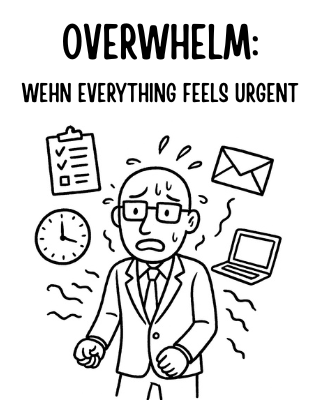
That’s why urgency creates a specific kind of mental state:
You jump from task to task without a clear sequence
You feel busy all day but end the day unsatisfied
You overthink small decisions and rush big ones
You become more irritable, more forgetful, less creative
You lose your ability to prioritize—because everything feels like a priority
This is how high performers get trapped: not because they can’t handle pressure, but because pressure can quietly dismantle their clarity.
The clarity question that interrupts the stress loop
There’s a question I return to personally—and I use it with clients—because it interrupts that urgency spiral fast:
“What actually matters most right now?”
Not what’s loudest.
Not what others are demanding.
Not what’s emotionally charged.
What truly matters—in this moment.
This question works because it does something powerful: it shifts you from reaction mode into leadership mode. It forces your brain to stop chasing stimulation and start choosing direction.
It brings your “thinking brain” back online—the part of you that can evaluate, decide, and act with intention.
That’s why it’s such a game-changer. It’s not a productivity hack. It’s a mental reset.
Why naming priorities reduces anxiety
One of the biggest sources of anxiety for high performers is not “too much work.”
It’s too much work competing for the top spot in your mind.

When you haven’t named your priorities, your brain keeps trying to hold everything at once. That creates background tension—like having 27 browser tabs open and one of them is playing music, but you can’t find which one.
When you clearly name priorities, something settles.
Because anxiety often sounds like:
“I don’t know what I should be doing first.”
“If I do this, I’m neglecting that.”
“If I slow down, something will fall apart.”
“I can’t afford to make the wrong move.”
Clarity reduces anxiety because clarity reduces inner conflict.
Three reminders for high performers
Here are the three reminders I want you to keep close—especially during intense seasons:
1) Urgency multiplies when priorities aren’t named
When you don’t choose what matters most, everything competes for your attention. And your day becomes a series of interruptions instead of intentional actions.
2) One clear focus reduces anxiety dramatically
You don’t need to solve everything right now. You need a clear next move. Your nervous system calms when it senses direction.
3) Progress accelerates when attention is intentional
High performance isn’t about doing more. It’s about doing what matters—on purpose.
And I’ll add one more that often hits hard:
“You will never find time for anything. If you want time, you must make it.” — Charles Buxton
You don’t “find” time for what matters most. You decide. You protect. You choose.
How to use this in real life: a practical method
Let me give you a simple way to apply this today.
Step 1: Pause for 10 seconds
Just long enough to interrupt the stress reaction.
Step 2: Ask the clarity question
“What actually matters most right now?”
Step 3: Define the “one outcome”
If you had to define success in the next 60–90 minutes, what would it be?
Step 4: Choose the next best move
Not the perfect move. Not the entire plan. Just the next best move.
Step 5: Protect focus for a short block
20 minutes. 30 minutes. One hour. Even short protected focus creates momentum.
This method is powerful because it works even when life is chaotic. It doesn’t require ideal circumstances. It requires a decision.
What clarity is—and what it is not
Clarity is not having everything figured out.
Clarity is knowing what matters most next.

High performers often delay action because they want certainty first. But clarity isn’t certainty. Clarity is direction.
And direction is what gives you steadiness.
A reflection question to deepen the shift
Here’s a question I often ask clients when urgency is high:
“If I only moved one thing forward today that would genuinely matter a week from now… what would it be?”
That question cuts through noise fast.
Because in pressure seasons, it’s easy to live in reaction. But leadership requires choosing what matters most—even when everything is yelling.
Closing: You don’t need a life overhaul—just a clear decision
Clarity doesn’t require a complete life overhaul.
Often, it starts with one decision:
What matters most right now?
What am I committing to next?
What will I let wait?